Product Overview
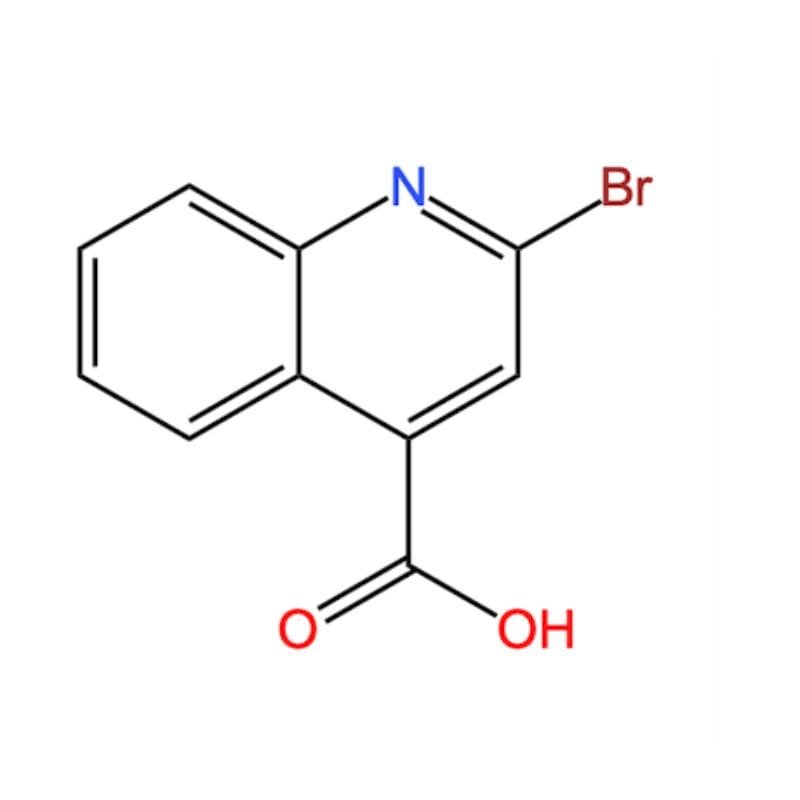
High-purity 2-bromo-4-quinolinecarboxylic acid is a versatile brominated heterocyclic building block for pharmaceutical and materials research. The strategic positioning of bromine (C-2) and carboxyl (C-4) groups enables diverse functionalization via cross-coupling, metalation, or condensation reactions.
- IUPAC Name: 2-Bromoquinoline-4-carboxylic acid
- Synonyms: 2-Bromo-4-quinolinecarboxylate; 2-Bromochinolin-4-carbonsäure
- CAS Number: 15733-87-6
- Molecular Formula: C10H6BrNO2
- Molecular Weight: 252.07 g/mol
- Structural Features:
- Bromo-substitution at C-2 enables cross-coupling
- Carboxyl group at C-4 for amide/ester formation
- Aromatic quinoline core for π-stacking interactions
Specifications
| Parameter |
Specification |
| Appearance |
Off-white to yellow crystalline powder |
| Purity (HPLC) |
≥98% (standard), ≥99% available |
| Melting Point |
210–215°C (dec.) |
| Water Content (KF) |
≤0.5% |
| Heavy Metals |
≤20 ppm |
| Halogen Content |
30.5–32.5% (theory: 31.7%) |
Physical & Chemical Properties
- Solubility:
✔ Soluble: DMSO (50 mg/mL), 1M NaOH
✔ Partially soluble: Hot methanol/ethanol
✘ Insoluble: Water, hexane, ether
- Spectroscopic Data:
- UV (MeOH): λmax 254 nm, 310 nm
- IR (KBr): 1685 cm-1 (C=O), 1580 cm-1 (quinoline C=C)
- Stability:
- Stable at RT for 12 months in sealed containers
- Sensitive to prolonged UV exposure
Applications
- Key precursor for:
✔ Quinoline-based antimicrobial agents
✔ Kinase inhibitor scaffolds
✔ Antimalarial drug analogs
Chemical Synthesis
- Suzuki-Miyaura coupling substrate
- Lithiation/functionalization at C-3 position
- Dirhodium catalyst ligand
Materials Science
- Building block for OLED materials
- Coordination polymers via carboxyl group
Packaging & Supply
Standard Packaging
| Quantity |
Packaging |
Special Features |
| 100 g |
Aluminum foil bag |
Oxygen barrier |
| 500 g |
Aluminum foil bag |
Oxygen barrier |
| 1 Kg |
HDPE bottle |
Desiccant included |
| 5 Kg |
Fiber drum |
UN-certified |
Special Options
- Custom concentrations (0.1–1M solutions in DMSO/DMF)
- Milligrams to kilogram-scale production
- Isotope-labeled versions (13C/15N)
Storage & Handling
- Storage:
- 2–8°C in original packaging
- Argon atmosphere recommended for long-term storage
- Handling:
- Use nitrile gloves and dust mask
- Avoid contact with strong oxidizers
Quality Documentation
- Certificate of Analysis:
- Batch-specific HPLC, NMR (¹H/¹³C), MS
- Elemental analysis report
- Regulatory Files:
- SDS (OSHA/GHS compliant)
- Reach registration dossier